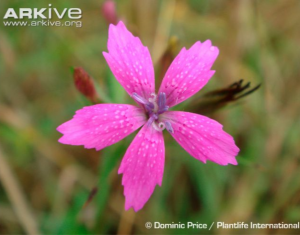
Deptford Pink | Dianthus armeria
Species Action Plan
Author: Nick Crouch
Lead agency: Nottinghamshire County Council
Publication date: October 2016
Current status
Deptford Pink is a biennial plant, flowering mainly in July and August. It favours well-lit, free draining grassland sites on a range of substrates which experience occasional disturbances, such as erosion or the actions of grazing animals. Until the beginning of the 20th Century, it was widespread and locally frequent across southern England (with a few sites in Scotland and Wales), and prior to 1950 it had been recorded in 293 10km squares in Britain. However, by 2003 populations were recorded at just 33 sites. Declines are attributed mainly to the loss of common land, the abandonment of traditional management practices, and overgrazing (it is very palatable to most grazing animals).
The construction of the national railway network in the 19th Century was exploited by the Deptford Pink, as the associated strips and patches of drought-prone, stony substrate with little competing vegetation are ideal for this species. 11% of all records come from railway habitats, and it is thought that seed may have been carried around in railway ballast from other sites, or directly from quarries where Deptford Pink grew. It can still be found on four current or former railway sites, and it is on such a site (a railway test track) that it grows in Nottinghamshire, near Widmerpool. It was first found here in 1991, and there are no previous records from the county.
The Widmerpool plants currently occupy a single, fenced-off area into which they were translocated in 2003, when basal rosettes from the original location (further to the north) were lifted and transferred to allow construction works to occur. Other, less successful mitigation works were also undertaken (including scrub clearance and the transferal of ballast), but the planned construction works never took place and the original colony had fully recovered by 2005. Seed was also collected and sent to the seed bank at Wakehurst Place. The following background papers provide further details about the Widmerpool colony: notes from a site visit by PlantLife (plus others) on 12th August 2005, and notes produced by Richard Carter of Carter Ecological (who oversaw the translocation works). Copies of both are held by Nottinghamshire County Council.
However, the planned construction works did eventually take place in 2011, and the original colony was destroyed. However, a second translocation took place, to second fenced-off trackside area immediately adjacent to west of the first which again proved to be successful.
Regular monitoring has established that the Nottinghamshire population is relatively stable, although numbers can vary quite significantly between years; the reasons for these fluctuations are not understood, but may be a result of climatic variations.
Targets
- Maintain a viable population of Deptford Pink at its current Nottinghamshire location
- Increase the population size by 25% above the 2008 baseline by 2025
Threats
- Scrub encroachment and competition by invading vegetation (which can be partly due to a lack of grazing by rabbits, leading to a loss of ground disturbance and a lack of germination opportunities)
- Over-grazing by rabbits
- Spraying of trackside vegetation with herbicides
- Construction/engineering works associated with the railway test track
Current initiatives
- Deptford Pink is a Species of Principal Importance under Section 41 of the Natural Environment and Rural Communities Act (2006), making it a focus for conservation action at a national level
- The species is legally protected under Schedule 8 of the Wildlife and Countryside Act 1981
- The species is one of 100 species of plant and fungi included in Plantlife’s endangered species recovery programme Back from the Brink, for which there is Species Dossier and Species Briefing Sheet
- Annual or near-annual counts currently take place at its only Nottinghamshire site
Proposed action
Policy and legislation
- Nothing proposed
Site safeguard and management
- Ensure that the presence of this species is considered in test track maintenance and vegetation management programmes
- Undertake habitat management to benefit this species
Species management and protection
- Consider undertaking experimental habitat management at the site to see if regeneration from the buried seed bank will occur
- Consider introducing this species to a new site at an appropriate location in Nottinghamshire
Advisory
- Ensure that the landowner and site manager(s) is advised of the importance of, and appropriate management techniques for, the conservation of this species
Future research and monitoring
- Arrange and undertake an annual monitoring programme, covering an assessment of population size, current management and potential threats
Communications and publicity
- Seek opportunities to publicise any positive actions taken by the site owner / manager(s) to benefit this species
What can you do?
- Please don’t try and visit the site - it is on active railway land with no public access
- Join a local or national wild plant conservation and study organisation, such as PlantLife or the Botanical Society of the British Isles
First published in 2015