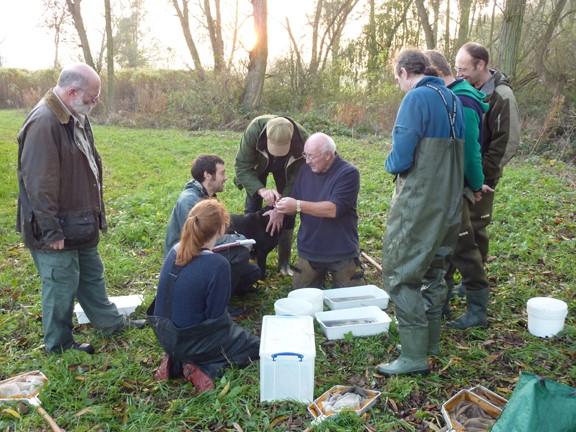
In November 2009 the Nottinghamshire Biodiversity Action Group (BAG) partnership brought together interested organisations and individuals to discuss the issue of crayfish conservation in Nottinghamshire. The catalyst for this meeting was the discovery on 11th September 2009 of a signal crayfish at Moor Pond Wood in the heart of the Leen Valley, which is a known white-clawed crayfish stronghold.
The meeting established that conservation work to benefit the white-clawed crayfish in Nottinghamshire should be reinvigorated. As a result of the meeting the following aims were identified as requiring further work:
- supporting the Nottinghamshire Crayfish Group and enabling members to gain more experience of working with the white-clawed crayfish
- coordinating survey work across the county
- maintaining a comprehensive data base for all species of crayfish recorded in the county of Nottinghamshire
- identifying the potential for crayfish ARK sites within Nottinghamshire
The future aims for group will be to try to discover the full extent of white-clawed crayfish distribution in the county and to try to monitor the existing known populations. In addition, it is hoped that the group can help with survey work to establish the full distribution of invasive non-native species of crayfish across Nottinghamshire with particular focus on the American signal crayfish.
The Future of Native Crayfish in Nottingham
Crayfish Plague and the Importance of Biosecurity
The main threat harming our native White-clawed crayfish populations is the spread of "Crayfish Plague". Crayfish plague is carried by invasive crayfish species, most commonly the American signal crayfish, who are immune to the effects of this deadly disease but are still able to pass it onto other individuals. White-clawed crayfish are affected the disease, and will die shortly after infection. Once the disease has been introduced to an area, an entire population of native crayfish can be rendered extinct within a short timeframe, often within a few weeks.
Crayfish plague is easily spread unless sufficient biosecurity measures are put in place. Anyone who utilises any kind of waterbody or waterway for activities such as walking, fishing, watersports, or even fieldwork, has a responsibility to stop the transmission of the Crayfish plague by practicing proper biosecurity techniques. The disease can remain infectious on poorly cleaned equipment for up to 22 days, so thorough disinfection should ideally be completed after every activity. Remember to follow the Check, Clean, Dry method to prevent spread.