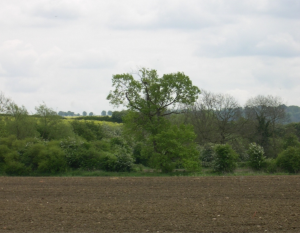
Black Poplar | Populus nigra
Species Action Plan
Author: Emma Woodrow & Nick Crouch
Lead agency: Canal & River Trust
Publication date: October 2016
Current status
The Black Poplar Populus nigra is distributed across Europe and middle Asia, and in Britain trees belong to the Atlantic race betulifolia (henceforth referred to as ‘native’ Black Poplar in this Species Action Plan) with the majority of the population found south of a line be-tween the Mersey and the Humber. Native Black Poplars are dioecious, which means that they are either male or female.
Land drainage, urbanisation and the canalisation of our lowland river floodplains, the natural habitat of the native Black Poplar, means that trees now survive where they were planted in the agricultural landscape, along watercourses, in field boundaries, and as parish markers. Trees were also planted close to villages because of their value for timber, which was used for building construction, for the flooring near fireplaces (due to its fire resistance), and for making wagon bottoms, rifle butts, and brake blocks (because of its shock absorbent properties).
A decline in these uses meant that few native Black Poplars have been planted in recent years, and nation-ally, there are thought to be fewer than 7000 mature trees surviving, of which fewer than 600 are females, although some estimates put these figures as low as 2500 and 400, respectively. Particular concentrations can still be found in the Vale of Aylesbury, and to a lesser degree in Shropshire, Somerset and Suffolk.
Elsewhere, including in Nottinghamshire, trees are thinly scattered, although surveys carried out in the county in 2006 and 2007 suggest that there are be-tween 800 and 1000 trees that appear to be of the native form in the county, mainly in the Greater Notting-ham, Mansfield and south Rushcliffe areas. However, just 1-2% of these are mature or semi-mature trees growing in natural or semi-natural locations; the majority are relatively newly planted as farm shelter-belts. Furthermore, just eight trees are known to be non-hybrid females (although more may exist).
The native Black Poplar is an important food plant for many invertebrates, including over 35 species of British macro moths, and for a considerable number of micro moths. Nottinghamshire moths of nature conservation importance for which it is a major food plant include Poplar Kitten Furcula bifida, Poplar Lutestring Tethea or, Dingy Shears Parastichtis ypsillon, Lead-coloured Drab Orthosia populeti, White Satin Leucoma salicis and Chocolate-tip Clostera curtula.
Targets
- Maintain the number and distribution of native Black Poplars in the county
- Increase the number of native Black Poplars in the county by 10% by 2025 by planting trees in natural or semi-natural locations and by planting more females in high male populated areas
- Increase the ratio of female to male native Black Poplars to approximately 1:20 by 2025
Threats
- Many of the remaining trees are isolated from one another, making natural regeneration difficult, a problem that is compounded by the fact that male trees significantly outnumber female ones, having been preferentially planted in the past as the large quantities of drifting white cotton covered seeds female trees produce were viewed as a nuisance; this has further reduced any opportunity for the trees to naturally regenerate.
- Native Black Poplar seeds are short lived and have very exacting germination requirements and the drainage of winter flooded meadows has resulted in the loss of suitable land for seedling germination and establishment; consequently, most of the remaining trees in Britain have probably been artificially propagated from cuttings; there is currently no known natural regeneration from seed
- The current lack of sexual reproduction means that native Black Poplars cannot respond to changing environmental conditions; molecular markers indicate that genetic diversity is lower in Britain than anywhere else in Europe, with much of the British population clonal in origin; most commercial stock is thought to originate from a single male clone
- The introduction of faster growing hybrid poplar species such as P. euramericana (a hybrid of European and American Black Poplar P. deltoides) and the consequential reduction in planting of native Black Poplar means that those mature trees which remain are old (most remaining specimens are estimated to be between 100 and 200 years old) and reaching the end of their lifespan, resulting in a gap in the age-structure of the species
- It is likely that misidentification has resulted in instances where cuttings have been taken from non-native poplars or hybrids in error for native Black Poplar
- Poplars, including native Black Poplars, are not welcomed in intensive horticultural areas, as they are the primary host of the lettuce root aphid (Pemphigus sp.), which forms galls on the petiole; ettuce is a secondary host, in which the aphid attacks the roots
- There is a risk of hybridisation with other subspecies or hybrids of Black Poplar
Current initiatives
- Surveys of the species were carried out in 2006 and 2007 to determine gender, location and numbers; periodic partial resurveys are ongoing Nottinghamshire County Council, working with the Sherwood Forest Trust, has established a GIS database recording the location of all known native Black Poplars in the county. This database will be maintained to include any new plantings or newly discovered mature trees.
Proposed action
Policy and legislation
- Nothing proposed
Site safeguard and management
- Ensure that native Black Poplars are considered in any management plans for all sites where they occur
- Seek to obtain Tree Preservation Orders for all native Black Poplars of confirmed origin growing in natural or semi-natural locations, and for all mature trees growing in any location, where it is considered that this would be beneficial and in the interests of public amenity
Species management and protection
- Maintain old trees to increase life expectancy by pollarding where appropriate
- Establish a stool-bed from which stock of known origin can be sourced
- Establish a programme of artificial propagation with a local university to pollinate female trees, collect resultant seed, germinate, and plant out seedlings
- Plant new trees of established native genetic origin to increase the overall number of trees and the number of locations at which they are present
- Plant female trees in appropriate areas located near males and preferably in areas where the seeds will be the least nuisance to the public
- Planting trees in locations with appropriate ground conditions (i.e. wet/damp), especially adjacent to watercourses
- Remove non-native poplars and hybrids where these occur in proximity to known female native Black Poplars
Advisory
- Raise awareness amongst farmers and residents living near native Black Poplars so that the value of these trees (and females in particular) is understood
- Produce an information sheet covering the management of existing native Black Poplar trees and the planting of new trees
Future research and monitoring
- Undertake periodic surveys of known sites to establish continued presence.
- Maintain a GIS database for all known native Black Poplars, to include recent plantings.
Communications and publicity
- Produce a press release at least once every three years regarding the native Black Poplar in Nottinghamshire.
What can you do?
- Report sighting of native Black Poplars to Nottinghamshire Biological and Geological Records Centre.
First published in 2015