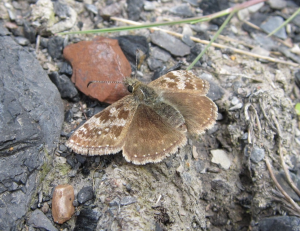
Dingy Skipper | Erynnis tages
Species Action Plan
Author: Kelsey Simpson & Nick Crouch
Lead agency: Butterfly Conservation East Mids.
Publication date: October 2016
Current status
The Dingy Skipper (Erynnis tages) occurs throughout England, Wales and parts of Scotland. Its stronghold is the Midlands and southern counties, but the species has declined by 48% nationally since the 1970s. Colonies occur in a range of open, sunny habitats; in Nottinghamshire, they are particularly associated with post-industrial sites. The larval foodplant is principally bird’s-foot trefoil, and suitable conditions occur where foodplants grow in a sparse sward, often with patches of bare ground in a sunny, sheltered situation. Taller vegetation is also required for shelter and roosting.
In Nottinghamshire, the species has experienced a decline and using criteria established by Butterfly Conservation, was categorised as “High Priority Regional Important” in 2000. This was because:
- There had been a significant decline in recent decades
- There were fewer than 30 colonies remaining
Between 1970 and 1988, the Dingy Skipper was found in 15 10km squares in Nottinghamshire. However, records from the Nottinghamshire Biological and Geological Records Centre and Butterfly Conservation’s East Midlands Branch show that from 1980 to 1998 the Dingy Skipper was noted in only 7 10km squares.
Recent recording has seen an increase in distribution, with the species being noted in 76 1km squares (19 10km squares) between 2006 and 2015, and 62 1km squares (19 10km squares) between 2011 and 2015.
| Period | 1970-1988 | 1980-1998 | 2006-2015 | 2011-2015 |
| No. of 10km squares | 15 | 7 | 19 | 19 |
| No. of 1km squares | Unknown | Unknown | 76 | 62 |
Sites supporting dingy skippers in Nottinghamshire are, in the main, of industrial origin, and a number may originate from unauthorised introductions. For the period 2006-2015, colliery sites (including restored pit tips and unrestored colliery yards) accounted for 57% of sites; disused railway lines accounted for 12%; and industrial areas (in use or abandoned) accounted for 8%. Restored sand and gravel workings, other types of restored quarry (including clay and gypsum mines) and semi-natural woodlands each accounted for 6% of sites, whilst semi-natural grasslands, airfields and cemeteries account for less than 2% of sites.
Targets
- Maintain current (2006-2015) distribution of the species
- Increase distribution to 90 1km squares by 2025
Threats
- Lack of habitat management, with a loss of open areas due to scrub encroachment
- Small and isolated population size making colonies vulnerable to loss and limiting the chance of recolonization
- Loss of sites, particularly post-industrial sites, to development
Current initiatives
- The Dingy Skipper is a Species of Principal Importance under Section 41 of the Natural Environment and Rural Communities Act (2006), making it a focus for conservation action at a national level
- The surveying and mapping of Dingy Skipper co-ordinated by Butterfly Conservation East Mid-lands has indicated that the species is now more widespread than previously
- Notts BAG partner organisations have informed private and public landowners about the presence of Dingy Skipper on their land, and given management advice to them on how best to manage areas for this species
Proposed action
Policy and legislation
- Nothing proposed
Site safeguard and management
- Determine ownership of all known sites for the species and inform landowners of their conservational importance
- Seek to establish and implement management plans for all sites that hold Dingy Skipper
- Identify potential sites for colonisation and ensure that they are brought into suitable condition
- Protect all known sites supporting the species from damaging development
- Carry out works to reduce fragmentation between populations
Species management and protection
- Ensure that the larval food plant is present on potential sites for colonisation
- Enhance egg-laying habitat through the creation of scrapes and ballast piles, where necessary
Advisory
- Produce a leaflet for site managers on habitat management for Dingy Skipper
Future research and monitoring
- Continue the recording of Dingy Skipper in the County
- Establish annual timed counts at key sites in order to measure year on year variations in population size
Communications and publicity
- Promote, by publicising the successful spread of Dingy Skipper, the worth of post-industrial sites as valuable habitats for wildlife
- Consider producing a leaflet for site managers on the management for skippers
What can you do?
- Report all sightings of Dingy Skipper to the county butterfly recorder, c/o Butterfly Conservation East Midlands
- Volunteer for practical conservation work on sites supporting, or with the potential to support Dingy Skipper
First published in 1998: Original authors - Michael Walker & Alan Birch (Butterfly Conservation East Midlands)