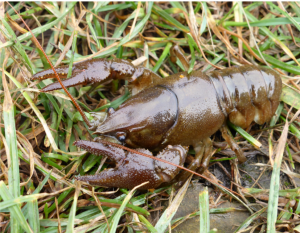
White-clawed Crayfish | Austropotamobius pallipes
Species Action Plan
Author: Alice Hudson & Chris Jackson
Lead agency: Nottinghamshire Biodiversity Action Group
Publication date: July 2017
Current status
The White-clawed Crayfish, Austropotamobius pallipes, has a broad distribution throughout Europe, with the greatest populations existing in the UK, France, Italy and Ireland. It is the only species of freshwater crayfish native to the UK, and the largest freshwater invertebrate in British waters. Across Europe populations have been sharply decreasing, and the species is now categorised as ‘Endangered’ on the IUCN red list, indicating a risk of global extinction.
White-clawed Crayfish prefer moderately hard, neutral to alkaline water containing reasonable levels of calcium. They can be found across a range of habitats in both flowing and standing water, most commonly in rivers and streams with good cover and little sediment.
Within the UK, the species has seen a rapid decline in its distribution since the 1970s (estimated at 50-80%), with significant population losses in areas that once supported strong populations (South West England, Peak District and the Ribble Valley). This has been primarily driven by three factors: 1) competition from six species of non-native crayfish introduced into UK waterways, 2) the crayfish plague (Aphanomyces astaci) carried by four of the six non-native crayfish species which is lethal to White-clawed Crayfish and 3) loss of habitat. Strong populations of White-clawed Crayfish still exist in South Wales, Suffolk, the East Midlands, Dorset, Somerset, Gloucestershire, Exmoor and the North York Moors. However, if the species continues to decline at current rates, it is predicted that White-clawed crayfish will be extinct in Great Britain by 2030.
Within Nottinghamshire White-clawed Crayfish are found in a number of river catchments to the west of the county, primarily those of the River Erewash, the River Leen and the River Maun. It is estimated they occur along approximately 10 km of river or stream in Nottinghamshire (including c.2 km in the River Erewash catchment, c.7 km in the River Leen catchment, and c.1 km in the River Maun catchment). Isolated populations also exist in a number of still waterbodies within the River Leen and River Ryton catchments.
Two non-native crayfish species are known to be present and breeding within Nottinghamshire, both from North America. Signal Crayfish (Pacifastacus leniusculus) are present throughout a number of river and stream catchments in the east and south of the county, including the Dover Beck, River Greet and River Soar. They are also believed to be present along the River Trent, but currently only a few records exist to confirm this. In 2013 a large population of Signal Crayfish was identified at Bulwell Hall Fish ponds, within the River Leen catchment. Spiny-cheek Crayfish (Orconectes limoosus) were discovered in 2002 within one of the water bodies at Attenborough nature reserve. Since then there has been no evidence to suggest that they have expanded their range into neighbouring water bodies.
Targets
- Maintain the current distribution of White-clawed Crayfish within the county up to 2025.
- Create a minimum of 5 White-clawed Crayfish Ark sites by 2025.
Threats
- The further spread of non-native crayfish populations within the county, as well as infiltration by non-native populations in neighbouring counties. Non-native species are able to outcompete the White-clawed Crayfish causing their decline, in addition, certain non-native species (e.g. Signal and Spiny-cheek) have the potential to carry the crayfish plague.
- To date, no known reports of crayfish plague exist within Nottinghamshire, however, little testing has been done. There is the potential for crayfish plague to spread into White-clawed Crayfish catchments, particularly where non-native populations exist in close proximity.
- The loss and / or damage of existing White-clawed Crayfish habitat through pollution and development.
Current initiatives
- In 2009 the Nottinghamshire Crayfish Group was established in response to the discovery of a single signal crayfish at Moor Pond Wood within the River Leen catchment. The group was set up to survey and monitor known crayfish populations, as well as act as an early warning system in the detection of non-native crayfish when they threaten native populations.
- Habitat enhancement works have been undertaken at a number of locations for the benefit of White-clawed Crayfish populations including at Mill Lakes (River Leen) and as part of the town centre improvement works in Hucknall.
- To identify potential White-clawed Crayfish Ark Sites within Nottinghamshire - Ark sites are isolated refuge sites, away from known out breaks of crayfish plague and populations of non-native species, where new White-clawed Crayfish populations can be established. These can include offline waterbodies or headwater streams. Initial survey work to identify potential Ark sites has been undertaken by a Nottingham Trent University student (Woodrow, 2015).
- A Nottinghamshire crayfish leaflet has been produced with the aim of informing fishermen and the public about crayfish within the county, highlighting the current status of all crayfish species in Nottinghamshire and UK crayfish legislation (http://www.nottsbag.org.uk/pdfs/NottsCrayfishLeafletFINAL_10.03.11.pdf)
- A baited trapping initiative is currently underway at Bulwell Hall fish ponds, in an attempt to eradicate the population of Signal Crayfish. The fish ponds are within 1 km of, and connected to, the River Leen, a known stronghold of White-clawed Crayfish within the county.
Proposed action
Policy and legislation
- Nothing proposed
Site safeguard and management
- Ensure that White-clawed Crayfish are considered in any management plans for sites where they are known to exist.
- Seek to identify a number of potential Ark sites within the county for White-clawed Crayfish.
Species management and protection
- Seek to establish the prevalence of crayfish plague amongst Signal and Spiny-cheek Crayfish populations within Nottinghamshire.
- Enhance existing White-clawed Crayfish sites through the addition of refugia.
- Investigate the potential for bank strengthening in areas with White-clawed Crayfish populations to minimise erosion and siltation.
- Generate potential risk/ impact zones for known populations of Signal and Spiny-cheek Crayfish within the county, to identify White-clawed Crayfish populations at particular risk.
Advisory
- Raise awareness amongst fishermen and residents living near and / or using water courses with known crayfish populations (both native and non-native), of UK crayfish legislation and how to prevent the spread of crayfish plague.
- Keep the Nottinghamshire crayfish leaflet up-to-date, covering new initiatives and up-to-date species distribution maps.
Future research and monitoring
- Undertake periodic surveys of known sites with White-clawed Crayfish populations to establish continued presence.
- Maintain a GIS database for all known White-clawed and non-native crayfish populations, to include possible risk /impact zones for known populations of Signal and Spiny-cheek Crayfish within Nottinghamshire.
Communications and publicity
- Produce a press release at least once every three years regarding White-clawed Crayfish within Nottinghamshire.
What can you do?
- Join, and report sightings of crayfish, to the Nottinghamshire Crayfish Group (e-mail: biodiversity@nottscc.gov.uk)
First published in 1998: Original author - Steve Betts